

Yearly Planning for Success | Phoenix Family Photographer
Intentional planning for family, health, and creative work.
A lot of people ask me, “How do you do it? How did you even find the time to do all that you do?!“
I hate to break the bad news to you: If you still haven’t found the time to start that one thing you always wanted to do, you will never find the time. Truth is — you will have to make time for it. We all know we have 24 hours a day. Unless you have some sort of magic, that’s what everyone gets every day. The key to getting the most bang for your buck when it comes to time is in planning.
Every January, I carve out a small pocket of quiet time to think about the year ahead. I like to review the past year to get insight into what went well and what needs adjustments. I want to know where I am headed before I start the journey.
Most of the time, it is not a dramatic reset. There’s no vision board party — I tried to host it before, but I needed the planning to happen at my pace without the pressure of comparison to others. Most of the time, I will reserve a study room at the library, or there are also a lot of drop-in coworking places where you can have a little office space to yourself for the day. I open my brand new planner and enjoy my favorite cup of coffee.
I often treat it as my appointment with myself and put it on our family calendar. This way, it is going to happen. As much as I love my family and my comfy home, there is something different about “going to work“ that helps with efficiency and the clarity of my mind.
As a homeschooling mom and a Phoenix family photographer, my year is shaped not just by “work hours” but by the rhythms of school days at home, and the very real limits of energy and time.
For a long time, yearly planning felt overwhelming to me. I thought it meant mapping out everything with great detail —school, work, health, goals—and making sure I didn’t fall behind before the year even started. I planned out my days down to the hours, months in advance. It was anxiety-inducing since I felt that my yearly goal setting equals my performance review for the past year, and I didn’t want to get a failing score. And very often, I fall “behind“ my goals because all my plans depend on everything working out the exact way I have planned and everyone else behaving exactly how I expected them to.
Over time, I’ve learned that the way I plan matters far more than how much I plan. I need a system with an outline instead of treating every day as a military rocket launch with execution precision.
Why “New Year's Resolution“ is Almost A Joke Nowadays
When you hear about people’s New Year’s Resolutions, it is almost a given that people are not going to take them seriously. We laugh about our resolutions falling apart by February. Why is that?
I’d set thoughtful goals — for homeschooling, work, health — and still find myself overwhelmed or quietly letting them fade. What I eventually realized was this: the issue wasn’t motivation. It was design. Most goals fail because they don’t account for real life. They’re often built for an ideal version of ourselves — more time, more energy, fewer interruptions. But real life, especially with kids, doesn’t operate that way.
Why I Start My Yearly Planning With Values
With my engineering background and my educational upbringing, I am very data-driven and detail-oriented. Even though they are good traits, they can cause problems if I focus too much on the specific goals in life. Most of the goals are great endeavors, don’t get me wrong, I am not saying that you should not set any specific goals, and just be vague. However, when rushing into setting a very specific goal, it might not be sustainable or even attainable. What’s worse, it might not even align with your values. In the past, I have set an ambitious goal to do a 365 photo project where I will take a photo each day following a specific prompt. I joined a group where a lead photographer releases a prompt each day in the morning and by the end of the day, there will be an example image the photographer had taken for the prompt. You get to follow along for the year. The project started strong, but quickly I realized that taking photos based on prompts sometimes needs extensive planning. Later, I also found many prompts or the specific interpretation of the prompt, did not represent what my values are in many aspects of life. I fell off the bandwagon, of course, and that spiralled into self-doubt on my ability to be consistent, and even worse, I doubted my capability of being a photographer or even a good person.
The following year, I tweaked my approach a little bit. I wanted to do this long-term project for a couple of reasons:
I value consistency and want to be better at it
I value creativity and want to spend more time experimenting with it
I value the honest record of my family life
It is not the sheer amount of photos I can create that I value. It is not being popular amongst my peers that I value. It is not the controversies that I value. It is not how I can follow others’ trends that I value. Then I set the goal: I will take at least one photo with my big girl camera each day of my life. I didn’t need the photos to follow a prompt from others; whatever caught my eye got documented. It is doable even when I am tired — I had many shots of my dirty sink at the end of the night, and they count. At the end of that year, I achieved all that I valued.
When I start with values instead of outcomes, everything else falls into place more naturally. This year, one of my biggest realizations was that I’m in a maintenance season for my business, not a scaling one. That clarity alone removed a lot of pressure. It gave me permission to focus on showing up consistently instead of constantly expanding. Effort more than result, progress over perfection.
Before I write down a single goal, I ask a different set of questions:
What do I want our days to feel like?
What actually matters in this season of life?
What am I not willing to sacrifice?
Planning Across Life and in Categories
After I have defined my values, I still plan homeschool goals, work goals, and personal goals separately — this way, I can modularize them. In my current season of life, I have made the choice to prioritize homeschooling, but it doesn’t mean that all my personal and career goals have to revolve around my kids. I want to model for my children how to balance all the responsibilities without tangling them all up. At the same time, I can also prioritize my goals better. When putting goals into different categories, I avoid having my goals too vague.
I know I just said that you should follow value first, but if the goal is generally too vague — I am going to get healthier this year — you don’t have any actionable steps to follow. Categorizing goals itself can help us break big goals into smaller achievable steps.
With that being said, I plan across life as well.
Homeschooling doesn’t exist apart from family rhythms.
Work doesn’t exist apart from energy.
Health doesn’t exist apart from time and support.
I have been training for my first full marathon in February. Challenging myself to show up consistently for my health has been a priority goal of mine for the past year. At the same time, it does take a lot of time and energy to maintain this goal. If I keep all my goals in separate categories, on paper only, it might look simple — there are hundreds of “first marathon training plans“ out there you can download. In real life, it looks more like putting together a puzzle — short runs between lessons, kids biking alongside me, or everyone moving together in their own way. Getting physical exercise helps tremendously with the attention and behavior of one of my children, while it means extra time and effort for another due to her special physical medical condition. Some days, school work comes first, while on other days, we all get to move our body first. Will I continue to train for full marathons? Also no. I know my schedule will change again for the next year and I won’t be able to spend so much time training for the full marathon. I can change my goal to run shorter races or even just to run 10 miles accumulatively each week. Sustainable goals live in the middle ground—specific enough to guide action, flexible enough to survive real life.

My daughter has trained with me enough to run multiple 5Ks a year. I decided to take my camera and photographed her run during the Phoenix Pancake Run in January 2025.
What I Intentionally Don’t Plan
One major lesson I have learned while observing my own life and photographing families in real life is that the most meaningful growth—whether in learning or in life—happens when there’s room to breathe.
There are a few things I leave open on purpose:
I don’t plan every homeschool day down to the hours.
I don’t plan outcomes for my kids.
I don’t plan to “do it all”.
Leaving space is part of the plan.
Some of the most meaningful learning and growth happen in the margins—in conversations, outdoor time, quiet curiosity, and shared experiences that can’t be scheduled. It is definitely easier said than done to follow values instead of specific goals, especially when we all feel the pressure from society, aka other moms or so-and-so’s child. It is important to remember that at the end of the day, progress towards the goal matters the most.
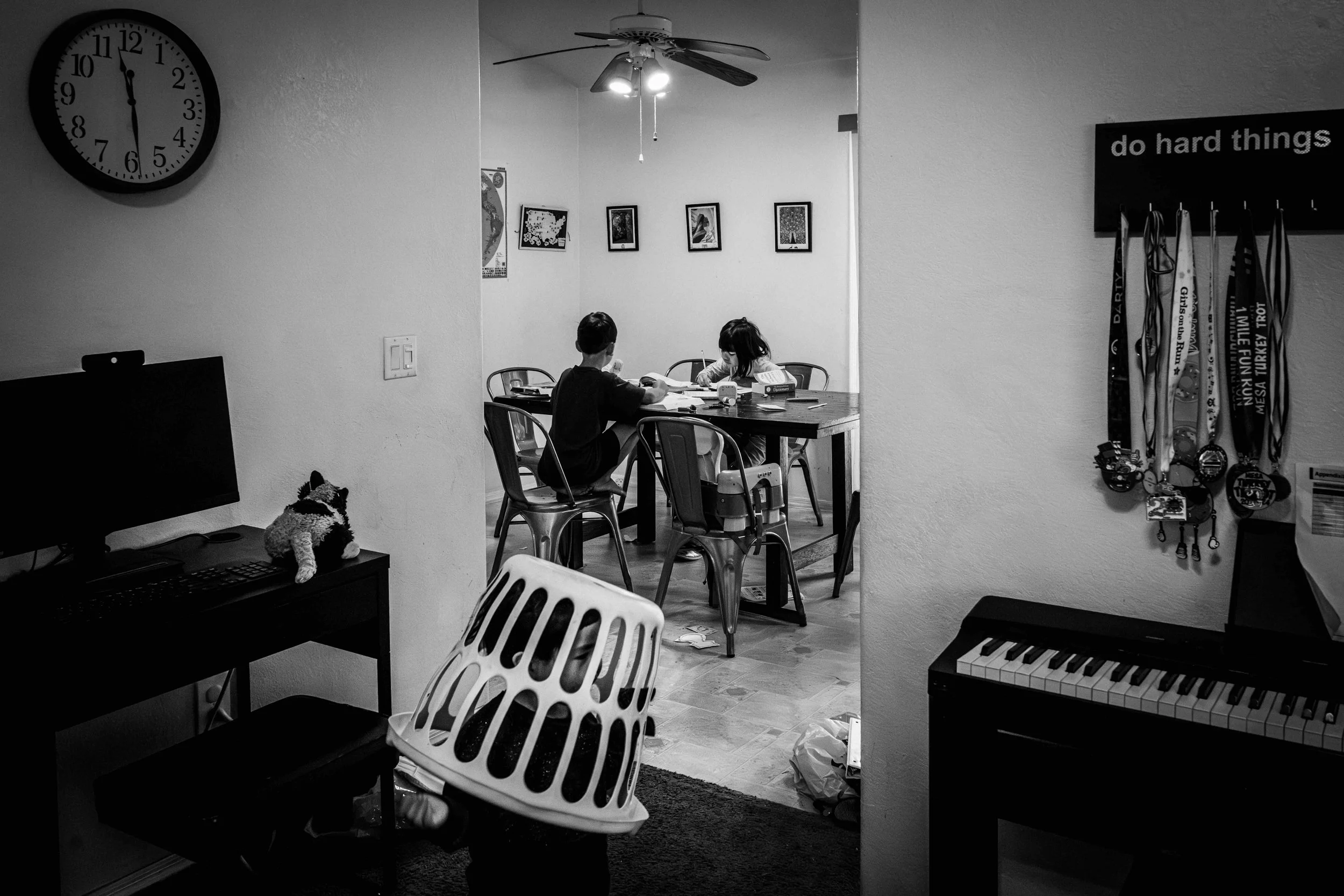
Don’t Forget to Celebrate Along the Way
I wish I could say that I can purely rely on willpower to achieve my goals, but in reality, I need incentives. I’m not saying that we need to award ourselves a chocolate chip cookie, or more like a large cup of boba milk tea, for every tiny task we have completed. However, let’s be honest, why not give ourselves something to look forward to as a celebration? How often do we fall into the trap of thinking “I am doing all these for nothing“ when things start to get rough and then we give up? If we intentionally plan a reward system for ourselves, be it an occasional boba treat or a big vacation, it motivates us. Sometimes, we just need a little external motivation to help us get into the habit and internalize the motivation.
If you’re setting goals this year — or feeling stuck with ones you’ve already named — I created a one-page Make It Stick reflection worksheet to help you pause and adjust before pushing forward.
It walks through simple questions like:
why your goal matters
whether it fits your current season
how to design it so it can survive real life
If you want to go deeper, the Goal Setting Workbook expands on these ideas with daily goals, habit tracking, weekly and quarterly reviews, and space to celebrate progress along the way.
The workbook is normally $17, and available for $9 during January with code “2026“.